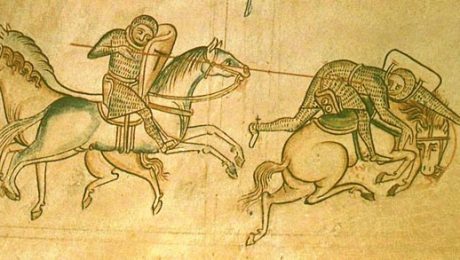
William Marshal died 797 years ago in 1219. At his funeral, Stephen Langton, Archbishop of Canterbury described him as the greatest Knight who ever lived. ‘The Marshal’, as he is known, was indeed a formidable character. As the fourth son of a relatively minor noble with little land to speak of he rose through the ranks, largely by his own devices, to immense power.
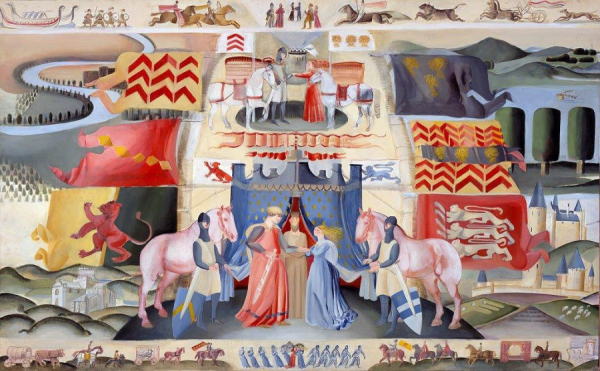
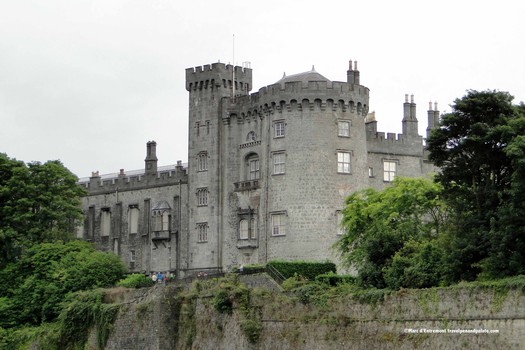
He served five Plantagenet Kings and was closely associated with the Knights Templar. He married a 17 year old heiress and became the ‘founding father’ of Kilkenny. Margaret M. Phelan credits him with having brought Kilkenny ‘into existence’.
He feuded with the Justiciar of Ireland, fell out with the Bishop of Ferns who attempted to excommunicate him, he vanquished the French at the battle of Lincoln and became Regent of England during the minority of the future Henry III.

When he died in 1219 he was buried in the Round Temple Church in London, with a plenary indulgence giving him direct access to heaven.
References
Images: The Marshal unseats Baldwin de Guisnes from Matthew Paris/Chronica Major — http://www.traditioninaction.org/History/C_009_Marshal.html
The marriage of Isabel de Clare and William Marshal. Panel 8. — http://www.rostapestry.com
Kilkenny Castle — http://www.irishhistorypodcast.ie/a-very-brief-history-of-medieval-kilkenny-in-pictures
The Round Temple Church — http://www.britania.com
Crouch, David, ‘Marshal, William (I)’, Oxford Dictionary of National Biography. Ed. H.C.G. Matthew and Brian Harrison. Oxford: Oxford University Press, 2004. p. 822
Asbridge, Thomas, The Greatest Knight. London: Simon & Schuster UK Ltd., 2015
Phelan, Margaret M. ‘William Earl Marshal (1144 – 1219)’ Old Kilkenny Review. N.S. Vol 2 No 5 (1983)
The Roads to Kilkenny
By the 14th century, Kilkenny was fast becoming Ireland's most important inland town as a result of the vibrant trade conducted between Dublin and Kilkenny, New Ross and Kilkenny, and the wider continent beyond. But travelling by road was dangerous and slow. Roads were difficult to traverse being often muddy and impassable, in addition, travellers were easy targets for foot pads and robbers. Keeping the verges clear of trees and undergrowth was vital in maintaining the safety of the communication networks by depriving would-be robbers of cover. On 24th June 1374, King Edward III granted John Traharn 100 shillings for his service in maintaining the ‘safe and secure custody of the roads from Carlow to Kilkenny…’, thus securing the communication networks vital for trade and thus the social and economic prosperity of Kilkenny and the Carlow Corridor, that region extending from Dublin to the south coast via Carlow.